

01 · The sponsor
Who submitted it.
The registered sponsor’s mark identifies the person or business responsible for submitting the piece for hallmarking.

A hallmark records the precious-metal content of a piece, following independent testing by an authorised Assay Office. It gives you reassurance that the metal meets the purity standard shown.
In the UK, jewellery sold as gold, silver, platinum or palladium must carry a legally recognised hallmark unless an exemption applies under the Hallmarking Act 1973.
01 · The sponsor
The registered sponsor’s mark identifies the person or business responsible for submitting the piece for hallmarking.
02 · The fineness
A number shows the precious-metal content in parts per thousand. For example, 750 represents 18ct gold, with 750 parts of pure gold in every thousand.
03 · The Assay Office
This symbol identifies the Assay Office. The UK has four: London, Birmingham, Sheffield and Edinburgh.
 A closer look at the marks inside a LIAV bespoke platinum engagement ring.
The marks inside your jewellery
The coloured stones inside the band are hidden birthstones. They are personal details and are unrelated to the hallmark.
Read the London Assay Office’s guide ↗Weight exemptions apply to lighter pieces. Items below the weights shown are exempt on weight grounds; other legal exemptions may also apply.
| Metal | Weight |
|---|---|
| Gold | 1 gram |
| Silver | 7.78 grams |
| Platinum | 0.5 gram |
| Palladium | 1 gram |
The official guide
Explore the symbols and metal standards in the British Hallmarking Council’s official notice, supplied by the London Assay Office.
Open the full notice ↗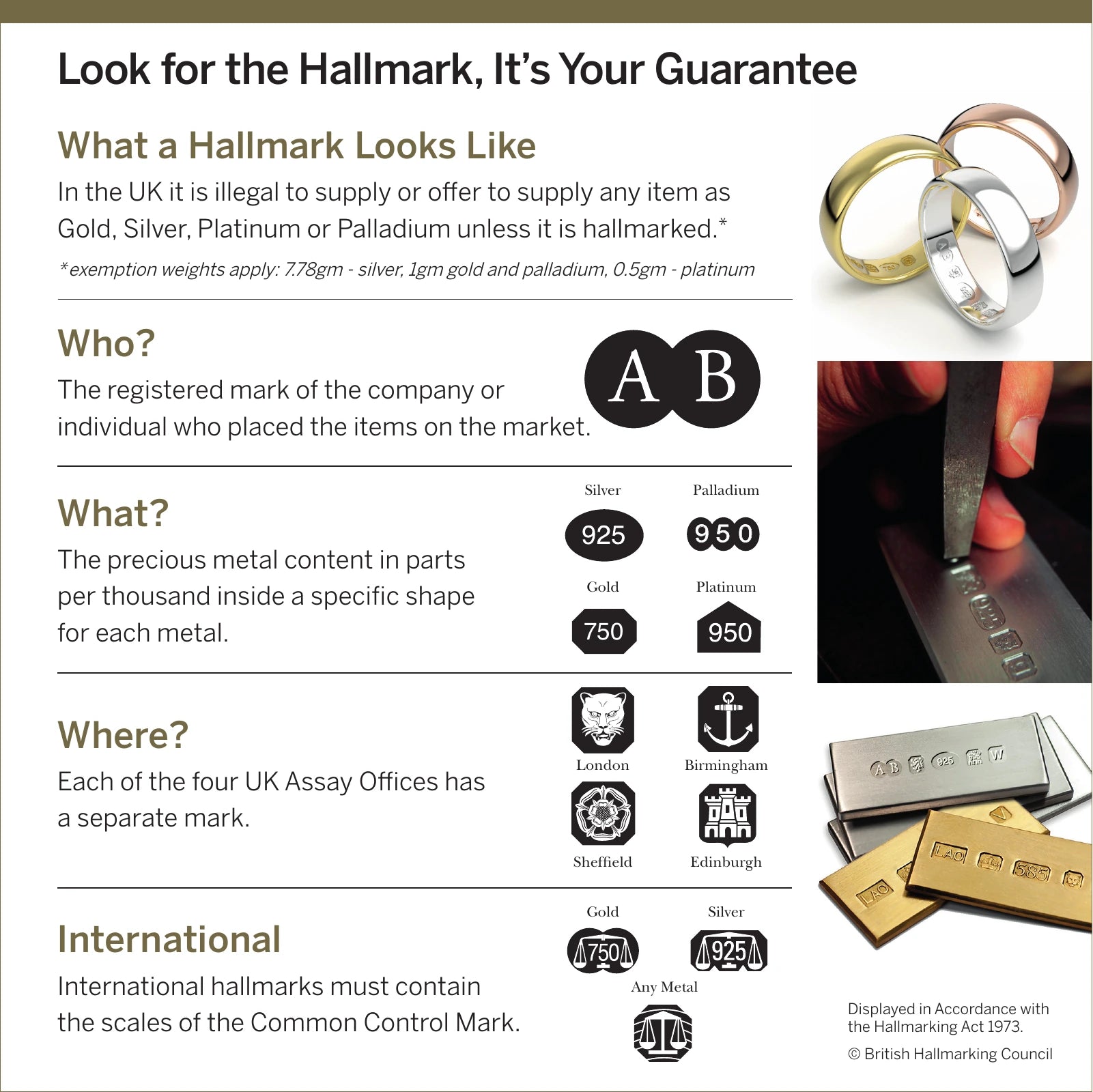
© British Hallmarking Council · Official notice reproduced without alteration.